Lesson 1

Nihongo wo yasashi de wa arimasen ga, omoshiroi des...

Introduction

Konnichi wa !!! If you are here, this means something... I see that you are interested in that, so let's go !!!!
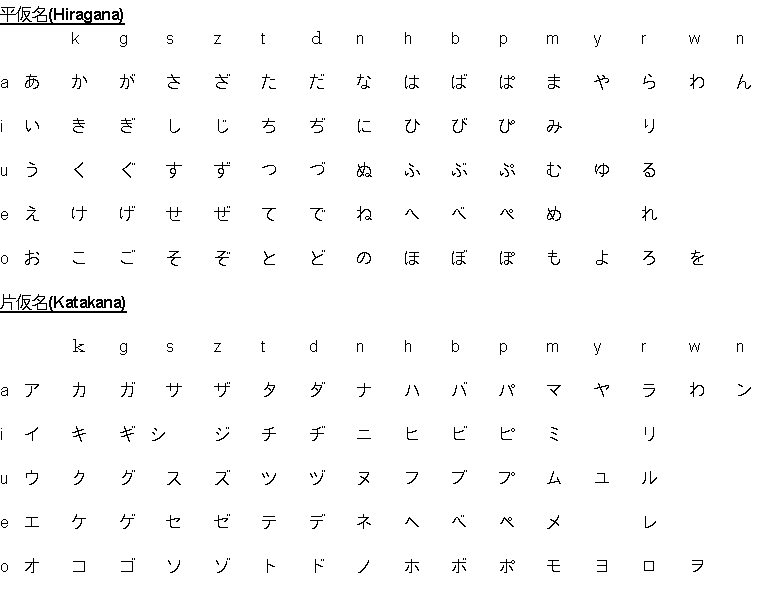
The Japanese language has many peculiarities. To begin with, it has not an alphabet, as ours. In fact it has two syllabaries, two syllabic "alphabets" called "Hiragana" and "Katakana", which have 50 symbols each. These syllabic symbols receive the name of "kana", either if they belong to Hiragana or Katakana.

Hiragana and Katakana


The Hiragana syllabary is usually used to write down Japanese words, and the Katakana is usually used to write down foreign words and onomatopaeia. And here you have the two syllabaries. The first table is the Hiragana and the second one the Katakana. In the first vertical column we find the vowels, then, we read, from top to bottom, a, i, u, e, o. From the 2nd column on (the one marked with a k) we read, from top to bottom ka, ki, ku, ke, ko. It is very easy and you will not have any problem.
(
Notes: S+i is pronounced "shi", z+i="ji", t+i ="chi", t+u= "tsu"  and h+u= "fu")

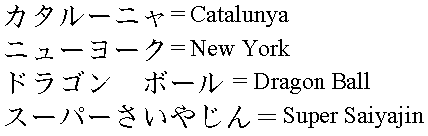
The only consonant which goes alone is the n. If your name is, for example, Esther, in Japanese kana you will have to write "Esuteru" to adapt the pronunciation of the word in English to Japanese (in katakana, it is a foreign name !!!!). The "u" is virtually unpronounced and it is nearly unnoticed when speaking... Here you have some examples.

If you'd like to practise the kana, this page is perfect.

And the "L"?


The sound "l" does not exist in Japanese. Then, what can you do when you must call somebody called Laura? The solution is to substit systematically any "l" by an "r", which is the most similar phoneme. Then the Japanese will not say Laura but Raura... (Yes, yes, I'm not wrong, this is just the contrary of Chinese...)

Pronunciation


The five vowels sounds in Japanese are a, i, u, e and o. But they are pronounced diferently from in English. This is the correct pronunciation:

   
a is pronounced ah as in barber
   
i is pronounced ee as in Greek
   
u is pronounced oo as in moon
   
e is pronounced eh as in leather
   
o is pronounced oh as in monster

Long and short vowels


The Japanese language has two different kind of vowels: the short vowels, which are "normal" vowels", as we know them, and the long vowels, which "make long" the sound of the vowels. This subtle difference is very important in a language with such a little phonetic scope as the Japanese.
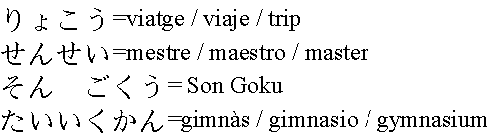
To mark a long vowel, in Hiragana we have to write an "u" after any syllable ended with an "o"  and an "i" after any syllable ended with an "i" or an "e". The other vowels cannot be "enlarged"...
Examples:
"Trip" is pronounced "ryokoo" but we must write "ryokou"
"Master" is pronounced "Sensee", but we must write "sensei"

But this rule is not valid in Katakana. When we must make long the sound of a vowel we must wite a line ( - ) after the vowel.
Examples:
"Catalunya" must be written as "Kataru-nya"
"New York" must be written as "Nyu- Yo-ku"

THAT'S NOT ALL FOLKS !

If you still have curiosity , click here !!!

Or then, go to the home page


You can send me your oppinion to: weezerx@usa.net